
MEASURING CARBON IN LANDSCAPE DESIGN
Using carbon estimates to inform design decisions
Carbon calculations are often used to evaluate a project after it has been designed. Their greater value may be earlier, while materials, planting strategies, and the treatment of existing site assets can still be changed.
This article examines how Climate Positive Design Pathfinder and i-Tree informed the design for a proposed burial ground. The analysis suggests that the assessed design elements could achieve a net-positive carbon balance in approximately eight years. It also highlights the importance of protecting existing mature trees and carefully considering how removed trees are managed.
Carbon as a design tool
A preliminary carbon estimate does not need to be a final accounting exercise. During design, it can help a landscape architect identify where emissions originate, compare alternatives, and strengthen the parts of a project that provide the greatest long-term benefit.
Useful design questions include:
· Which proposed materials contribute most to project emissions?
· Could a different material, construction detail, or layout reduce that impact?
· How long will new vegetation take to balance the emissions created during construction?
· What carbon is already stored in existing trees, soils, and vegetation?
· Which existing landscape assets should be protected, and how should removed material be managed?
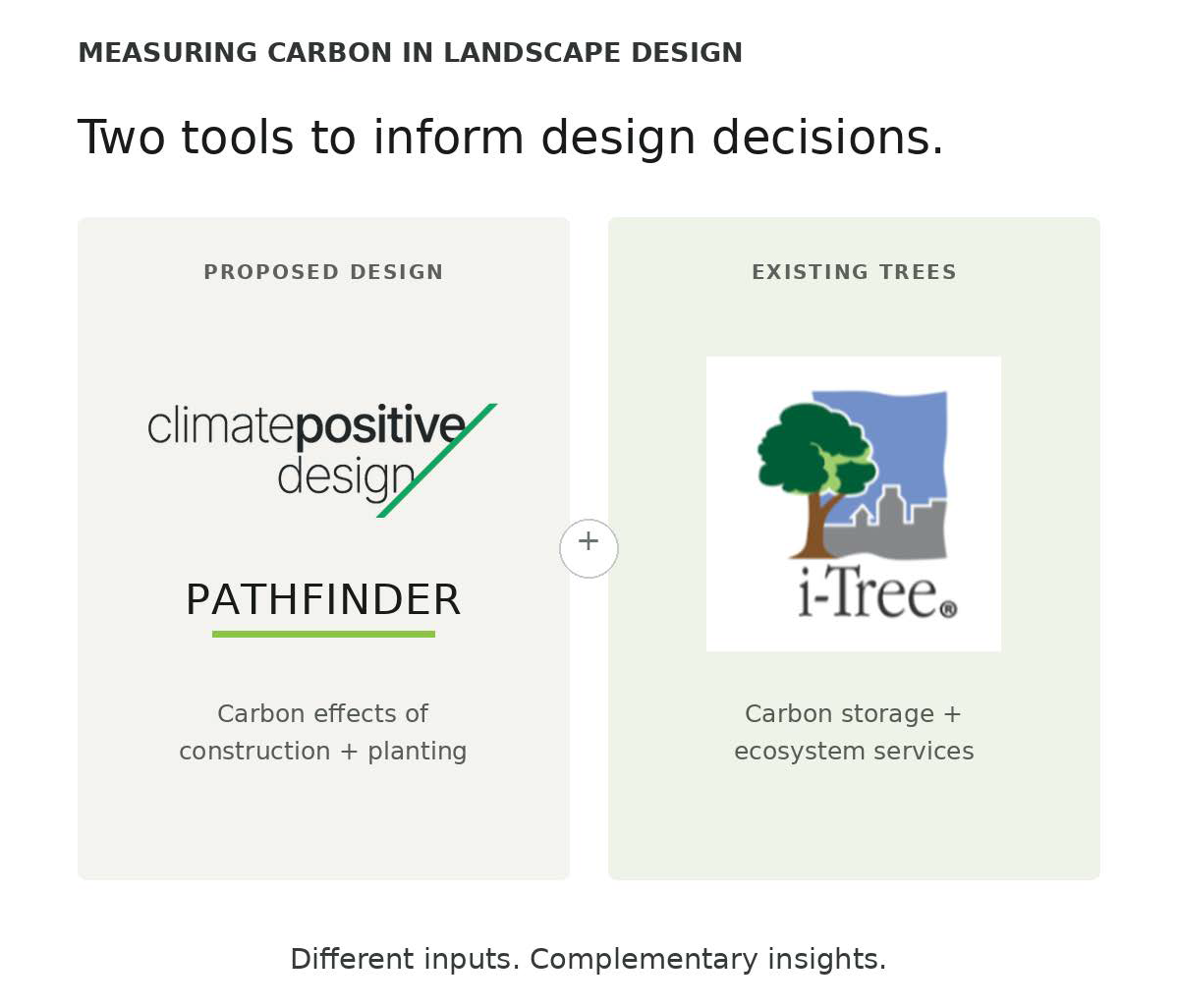
Pathfinder evaluates the proposed design; i-Tree evaluates existing trees and their ecosystem services.
Two tools with complementary roles
Landscape carbon is not captured by a single number or tool. Pathfinder and i-Tree use different inputs and answer different questions. For this project, their results are most useful when interpreted together but reported separately.
The models also use different assessment periods: the supplied Pathfinder scorecard covers 60 years, while the i-Tree forecast covers 20 years. Tree growth and mortality are not linear, so multiplying the i-Tree result by three would create false precision. The two results therefore should not be added into one combined 60-year total without a common-period forecast.
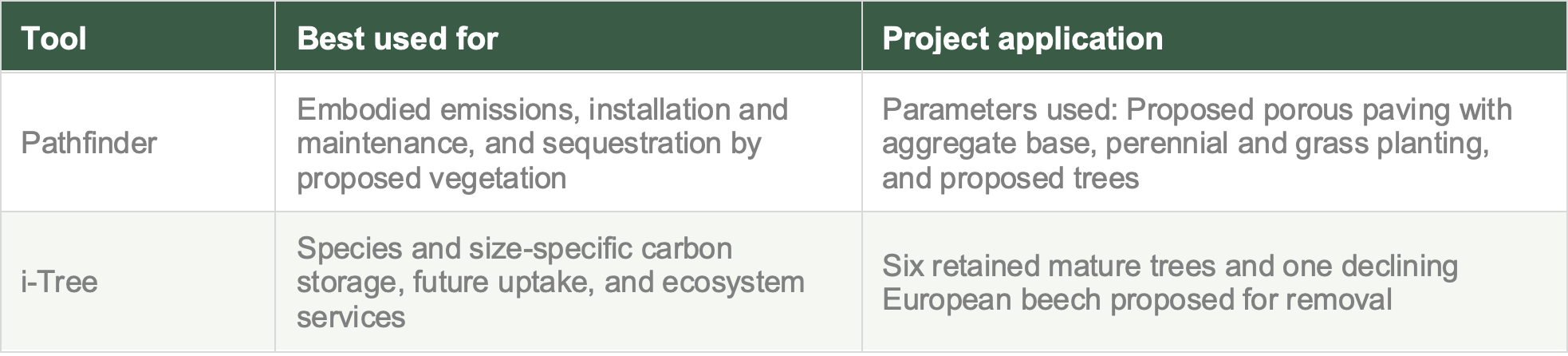
What Pathfinder showed about the proposed design
Pathfinder estimates the initial carbon cost of construction and the carbon removed over time by the proposed landscape. Existing trees were excluded from the Pathfinder analysis, preventing them from being counted twice.
The proposed porous path accounts for approximately 1.70 metric tons of embodied CO₂ emissions. The perennial and grass plantings provide the largest modeled planting benefit, while the proposed medium deciduous trees make an additional long-term contribution. These findings support retaining the proposed porous paving and planting strategy.
Pathfinder also allows transportation distances for materials and plants to be compared, making local sourcing a measurable design consideration. By selecting locally available materials and plants where possible, landscape architects can help reduce transportation-related construction emissions. For this assessment, the model assumes that both paving and plant materials will come from local suppliers.
The estimated eight-year carbon-positive point is a model result, not a guarantee. It depends on the assumptions entered into Pathfinder, including material quantities, transportation distances, maintenance practices, and successful plant establishment and survival. The model should be updated at the end of the design process and again using as-built information.
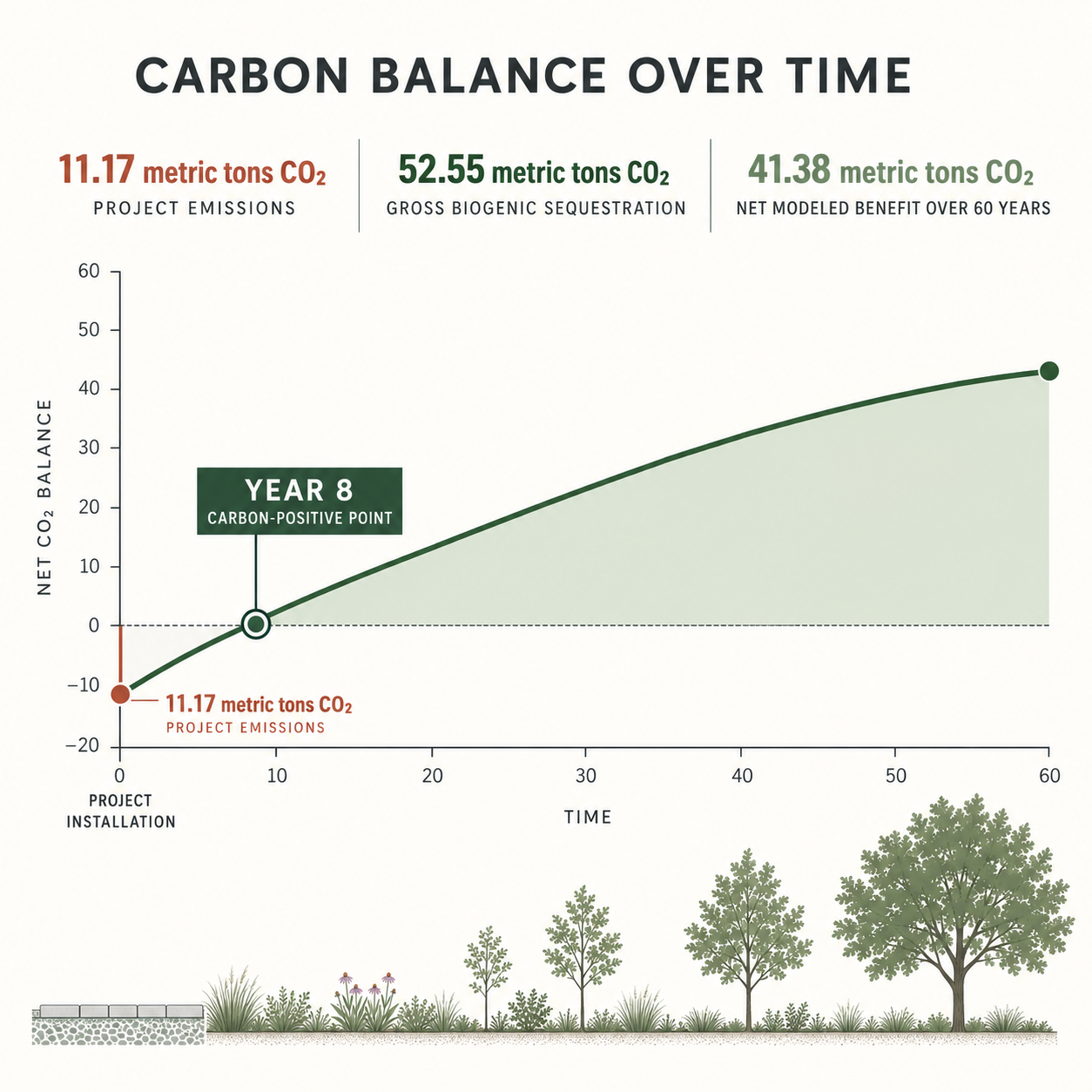
The proposed path and planting design reaches its modeled carbon-positive point in approximately year 8. (Conceptual visualization based on Pathfinder results.)
The carbon value of existing trees
Pathfinder describes the proposed work, but it does not provide a species-specific assessment of mature trees already on the site. Using i-Tree, the six large trees to be retained and a 66-inch-diameter European beech in poor condition that is proposed for removal. were evaluated The distinction between storage and sequestration is essential. The retained trees already hold more than 62 metric tons of CO₂ equivalent; that stored carbon is not a new project benefit. Their projected uptake of approximately 10.48 metric tons over the next 20 years is the additional benefit expected over time.
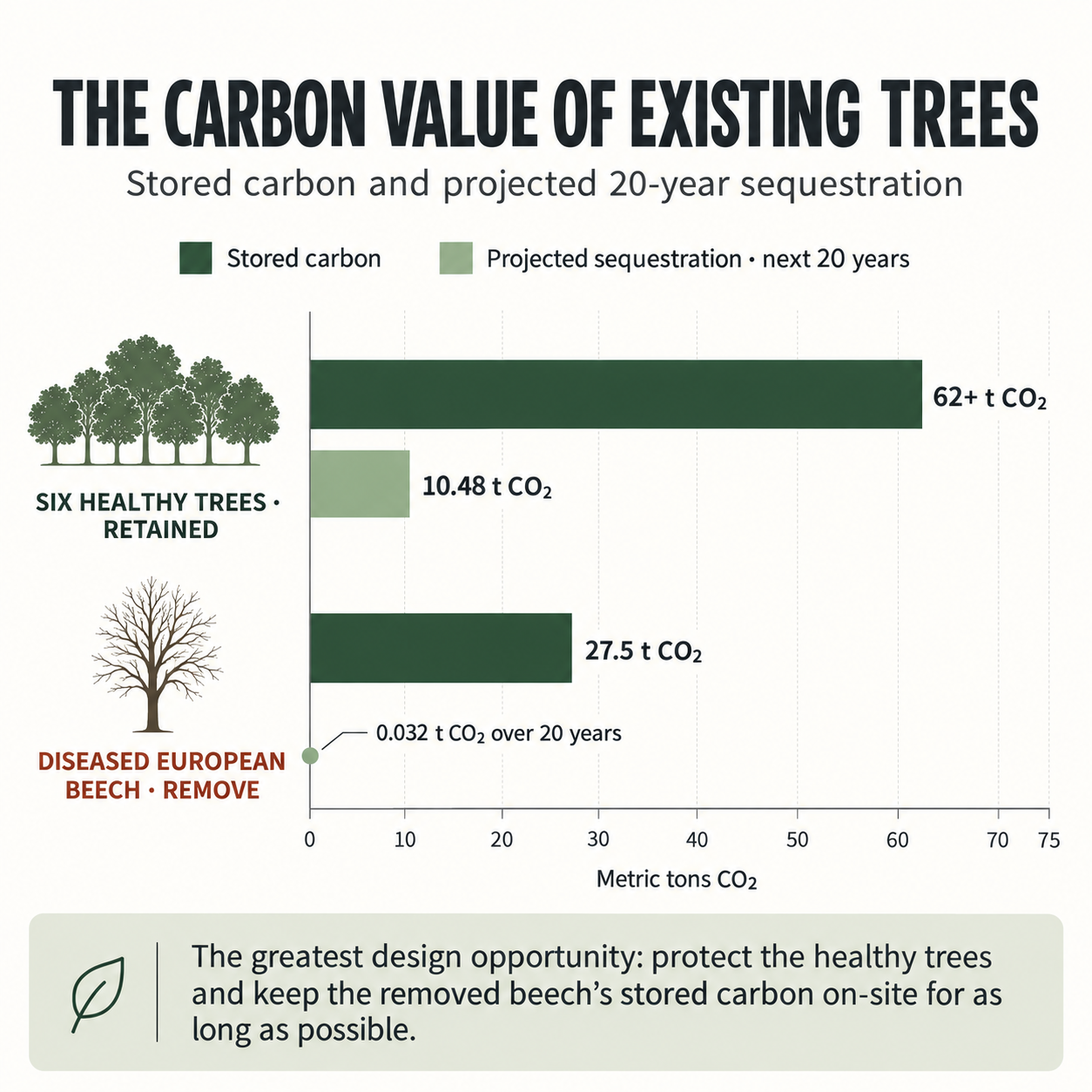
The graph shows the significant value of the stored carbon in the existing trees. Projected sequestration is the additional carbon trees are expected to remove over time.
Tree retention also protects stormwater benefits
Over 20 years, i-Tree estimates that the six retained trees will intercept approximately 628,514 gallons of rainfall within their canopies and prevent approximately 93,663 gallons of that rainfall from becoming surface runoff.
These are related but distinct benefits: intercepted rainfall includes water temporarily captured by the canopy, while avoided runoff estimates the net reduction in water flowing across the ground because of the trees.
These results reinforce a central design priority: protect the six mature trees during construction. Tree-protection, controls on soil compaction and grade change, and careful staging are as important to the carbon strategy as adding new vegetation.
Replacing turf beneath the retained trees with native plant communities will also improve soil structure, increase infiltration, and create a more ecologically functional understory. These benefits are important even when they are not fully reflected in the carbon model.
A removed tree still presents a design decision
The declining European beech is projected to sequester only about 32 kilograms of CO₂ over the next 20 years. Its removal therefore has little effect on future sequestration. The tree nevertheless contains stored carbon equivalent to approximately 27.5 metric tons of CO₂. That amount should not automatically be recorded as an immediate emission because the timing of its release depends on how the wood and roots are managed.
How quickly the stored carbon returns to the atmosphere depends on what happens to the trunk, branches, and roots. Suitable portions of the beech could be reused as seating or other durable site elements. Other portions could remain as nurse logs or coarse woody material. Decomposition would continue, but keeping material on site could delay some carbon release, reduce transportation and processing, and support fungi, insects, soil organisms, and habitat development.
What the assessment can and cannot claim
The available information supports a clear design conclusion: the proposed path and planting design has an approximately 41.4-metric-ton net modeled carbon benefit over 60 years and reaches carbon-positive status at about year eight. Separately, i-Tree projects approximately 10.45 metric tons of net tree-related CO₂ uptake over 20 years: 10.48 metric tons from the six retained trees, less approximately 0.032 metric tons of projected uptake associated with the removed beech.
It does not yet support a single precise combined 60-year benefit for both tools. Nor does it show that all carbon stored in the beech will be emitted when the tree is removed. The results are preliminary design estimates, not verified carbon credits or a formal whole-life-cycle assessment.
Why continued access to these tools matters
Free tools such as i-Tree are particularly important to small landscape architecture practices that may not be able to purchase specialized software or commission a detailed assessment for every project. Credible public tools allow them to quantify tree benefits, compare alternatives, and bring information about carbon and stormwater into conversations with clients and communities.
The future of that access is concerning. According to i-Tree, a change in USDA Forest Service policy indefinitely halted the program’s traditional funding. One-time public funding, support from Davey Tree Expert Company, and project-specific grants have helped keep the tools operating in the near term, but future updates and technical support may be limited. Dependable funding is essential if evidence-based ecological design tools are to remain accessible to small firms, nonprofit organizations, community groups, and municipalities, as well as larger organizations.